The Trial of Eichmann and the Banality of Evil
At the end of World War II, the world began to understand what had been done to the Jews under Nazi Germany. Especially after the Nuremberg Trials, documents, records, and testimonies revealed the scale of the violence committed by the regime.
However, it was in 1961, during the trial of an SS officer in Jerusalem, that the world fully grasped the almost industrial nature of the Holocaust in the persecution, torture, and extermination of Jews across Europe.
With the fall of the Third Reich after the war, many German officials fled Europe to South America, particularly to Argentina.
Among them was Adolf Eichmann, the man responsible for the logistical machinery of the Holocaust — a typical bureaucrat in a suit and tie, soft-spoken and outwardly ordinary. Hidden in Argentina, he lived with his family for nearly ten years before being discovered by Israeli intelligence.
The Mossad carried out a covert operation and brought Eichmann to Jerusalem, where he would stand trial for crimes connected to the Holocaust.
The trial lasted eight months and was broadcast internationally. Hundreds of survivors and family members testified about what had taken place in the concentration camps, the trains, the gas chambers, and the entire structure designed to eliminate Jews across Europe.
It was at that moment that the world was able to witness the Holocaust from the perspective of the victims, rather than through the lens of soldiers, military documents, or political authorities.
The logistics of genocide
During the Nazi regime, Eichmann was responsible for technically organizing transportation, schedules, documentation, records, deportations, transfers, and every form of bureaucracy involved in the logistics of the Holocaust.
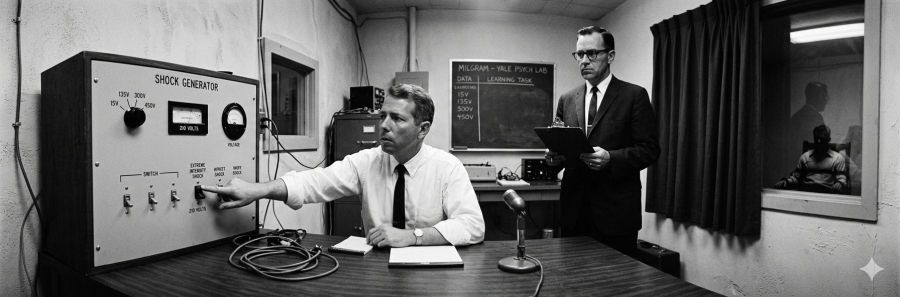
His role was not to pull the trigger or personally administer punishment. In essence, it was paperwork, meetings, and administration — pure bureaucracy. Yet that administrative character was precisely what made the machinery of extermination far more efficient and dangerous.
A single signature could determine the fate of an entire neighborhood on its way to a concentration camp.
It was an industrialized system of death — measured, calculated, and optimized for efficiency. Not a chaotic massacre, but a cold, rational, and carefully engineered process.
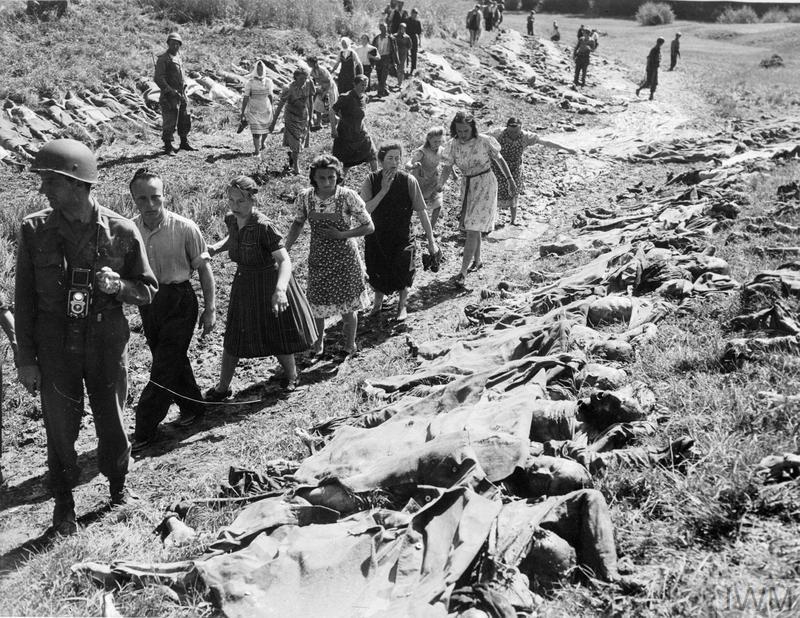 German civilians forced to witness Holocaust victims
The illusion of the monster
When people imagine someone capable of participating in the deaths of thousands, they often picture a visibly violent, cruel, or disturbed individual.
But Eichmann contradicted that perception.
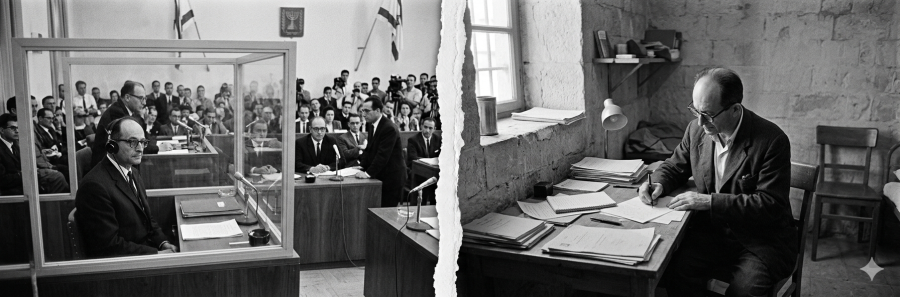
During the trial, the world saw a man in a suit and tie, wearing thick glasses, speaking in a quiet administrative tone, constantly attempting to present himself as a good employee simply fulfilling his duties.
It was this image that later led Hannah Arendt to formulate the concept of the “banality of evil,” arguing that crimes such as the Holocaust can be carried out by ordinary people operating within hierarchical systems that dissolve personal responsibility.
“I was only following orders”
During the trial, Eichmann uttered several phrases that revealed how he viewed his own role within the system he helped sustain.
“I never killed a Jew, or a non-Jew. I never killed anyone.”
This statement reflects the disconnect Eichmann perceived between his daily activities and the final outcome of the system in which he operated.
“I was only following orders.”
It became one of the defining statements of the trial and illustrates how individual responsibility can dissolve within large hierarchical structures.
The larger the structure:
- the smaller the individual perception of guilt
- the greater the distance between action and consequence
- the easier it becomes to frame moral decisions as technical tasks
Each participant performs only a small part:
- one signs
- another approves
- another inspects
- another transports
- another records
And the accumulation of many small acts can ultimately produce catastrophic consequences.
“I was just a small cog in the machine.”
This was how Eichmann attempted to portray himself within the Nazi system, consistently trying to transfer responsibility upward.
That logic does not belong exclusively to the Third Reich — it remains present in military institutions, large corporations, financial systems, criminal organizations, and many other highly hierarchical environments.
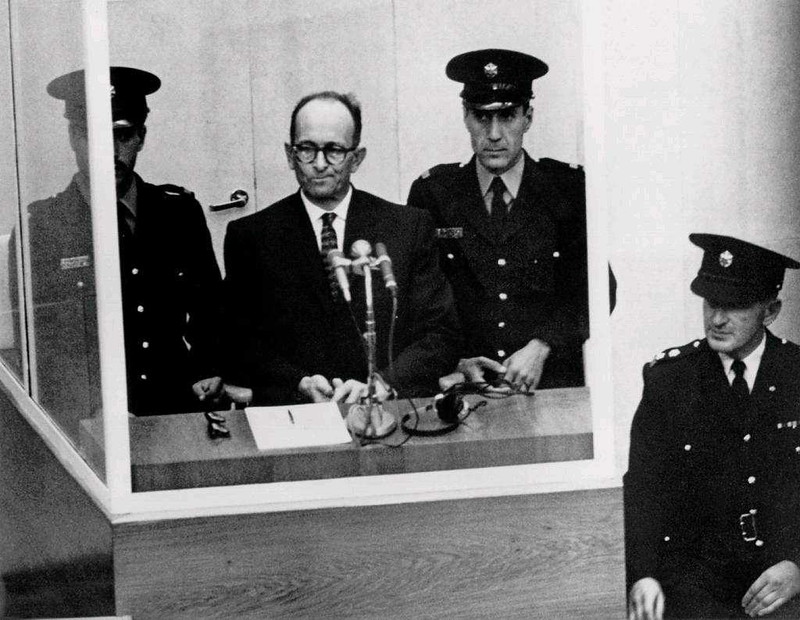 Adolf Eichmann during the trial
Technical language and emotional distance
Bureaucracy offered an extermination machine more than efficiency alone.
The very tendency to constantly rely on technical terminology helped emotionally reduce the impact of the tasks being carried out:
- deportations were referred to as “evacuations”
- deaths became the “Final Solution”
- slave labor was reframed as “forced labor in camps”
Lives and personal histories were transformed into numbers, lists, and reports.
This mechanism still exists today in many modern structures through softer or technically neutral expressions such as:
- collateral damage
- operational optimization
- humane downsizing
Bureaucratic language often functions as a form of moral distancing.
The real problem remains
The trial of Adolf Eichmann is not merely about the war crimes of an SS officer. It exposes how complex hierarchical structures are capable of diluting individual responsibility and enabling morally questionable actions to be carried out.
Even today, political groups, large corporations, and actors within the financial system meet behind closed doors, make decisions, and create agendas that delegate millions of small actions to ordinary people — actions capable of affecting entire societies in harmful ways without direct accountability for those responsible.
Conclusion
It is common to imagine evil as something explicit, easily identifiable, almost caricatured. But history shows that large systems do not necessarily require monstrous individuals.
Often, they require only:
- pattern
- routine
- conformity
- hierarchy
- administrative obedience
This is ultimately about culture, structure, and obedience — and about how these factors combine to make large-scale atrocities possible without requiring individuals to openly present themselves as monsters. About how human passivity and moral detachment can be used to achieve ends that would rarely be accepted on an individual level.
The danger lies not only in authoritarian leaders, but also in what ordinary people become capable of doing when they obey systems without questioning the consequences of what they help sustain.
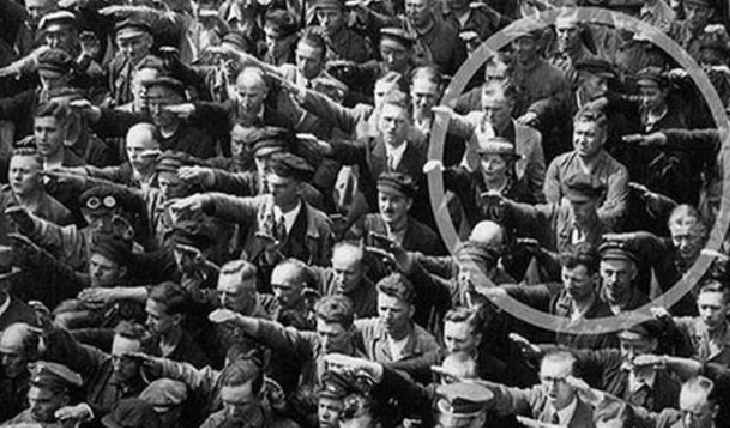 August Landmesser refusing the Nazi salute
References
-
Hannah Arendt.
Eichmann in Jerusalem: A Report on the Banality of Evil (1963) -
United States Holocaust Memorial Museum.
https://encyclopedia.ushmm.org/content/en/article/adolf-eichmann