Operation Paperclip: Nazis as American heroes
With the end of World War II, it was widely expected that those responsible for atrocities committed against civilians would face severe and exemplary punishment.
History, however, has repeatedly shown that justice and ethical principles are rarely absolute priorities for nations and governments.
Wars create conditions in which cruel individuals are able to externalize the very worst aspects of human nature. Yet Nazi Germany remains particularly singular in this regard. Whether because of the historical period, the cultural context, or the unprecedented technological development of the era, cruelty reached previously unimaginable levels: mass killings, medical experiments on adults and children, forced labor until death, and the systematic industrialization of human extermination.
The world was horrified by the Holocaust, the Soviet gulags, the atomic bombings, and many other immoral processes that emerged during the war. Even so, for modern states, such actions were often treated as part of the logic of defeating enemies and imposing maximum domination over them.
As Germany’s defeat became increasingly inevitable, Operation Paperclip was created, setting aside moral principles and legal concerns in favor of strategic interests. Its purpose was to secure human and technological resources capable of further strengthening the American military machine. The operation consisted of recruiting German scientists, engineers, and specialists to work in the United States.
Many of these men were members of the Nazi Party; others belonged directly to the SS. Some were connected to slave labor in concentration camps, medical experiments on prisoners and children, and a variety of morally questionable projects carried out under the regime.
Beyond absorbing technical expertise, the operation also sought to prevent the Soviet Union from obtaining these specialists for its own military and scientific programs.
Operation Paperclip reveals a recurring pattern in modern international politics: states rarely operate solely according to the principles they publicly claim to defend. In contexts of strategic competition, technical knowledge, military superiority, and operational capability frequently take precedence over ethical considerations.
Operation Paperclip
In 1944, Werner Osenberg, head of the German Military Research Association, compiled a list containing the names of German scientists and their respective areas of expertise. By chance, this list — later known as the “Osenberg List” — fell into the hands of a Polish technician, who passed it to British MI6 intelligence. It was subsequently shared with American intelligence services.
With the list in hand, Major Robert Staver prepared a version identifying which scientists should be captured and interrogated by the United States. From this effort emerged Operation Overcast, whose original mission was merely to interview these specialists.
However, once the Soviet Union began capturing and transferring German scientists to its own territory, the operation’s purpose changed. Operation Overcast was expanded and eventually renamed Operation Paperclip.
Officially launched in May 1945, it became a secret program administered by the Joint Intelligence Objectives Agency, linked to the Pentagon, with the objective of recruiting German scientists, engineers, and technology for the American military-industrial complex.
It is estimated that around 1,600 German specialists were transferred to the United States under secret military contracts.
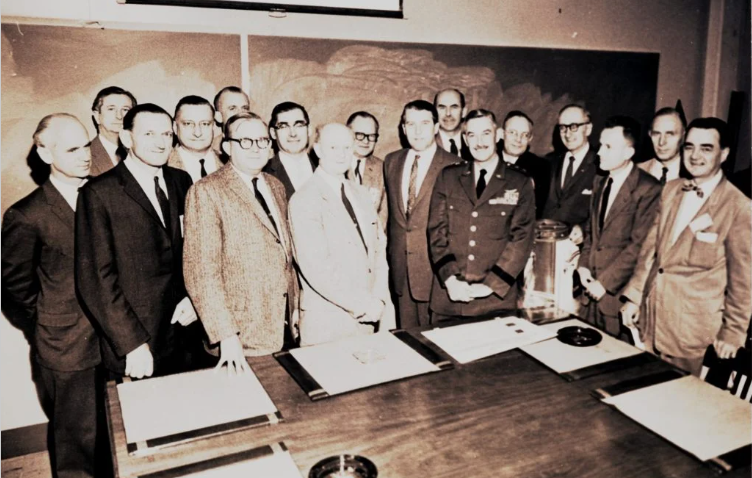
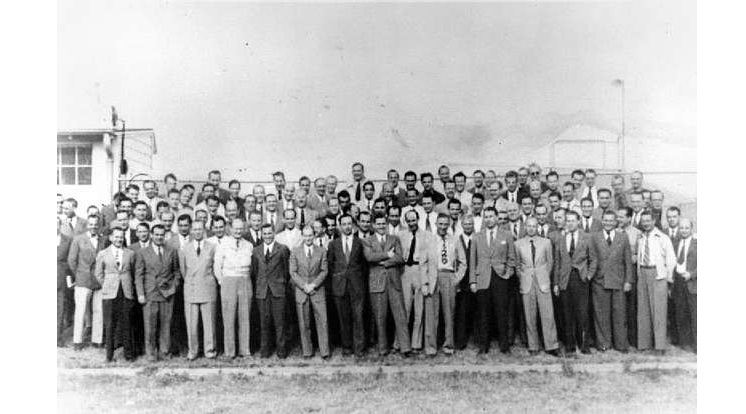 The original Paperclip team at Fort Bliss, November 1946
Equivalent Operations in Other Countries
The competition for German scientists was not exclusive to the United States. Other victorious powers also organized similar programs to capture technical knowledge and prevent rival nations from gaining strategic advantages.
Soviet Union — Operation Osoaviakhim
Conducted in 1946, Operation Osoaviakhim involved the forced transfer of thousands of German scientists, engineers, and technicians to Soviet territory. In addition to specialists in rocketry and nuclear energy, entire laboratories and industrial equipment were dismantled and rebuilt inside the Soviet Union.
The Soviets primarily used these specialists in ballistic missile programs, aviation, and nuclear development. The operation played a fundamental role in accelerating Soviet military projects during the early years of the Cold War.
United Kingdom — Operation Backfire
The British also conducted operations aimed at capturing German technology. Operation Backfire focused primarily on the study and testing of German V-2 rockets after the war.
German engineers were used to reassemble and launch rockets under British supervision, allowing the United Kingdom to directly study technology developed by the Third Reich. Although smaller in scale than Operation Paperclip, the initiative contributed significantly to the early development of European rocket programs.
France
France also recruited German scientists and engineers after the war, particularly specialists in aeronautics and weaponry. Many were integrated into French research centers and later contributed to the development of the country’s aerospace industry in the following decades.
The Most Important Scientists: During and After the War
Wernher von Braun
The most prominent among the recruited scientists. An honorary SS major and the leading figure behind the development of the V-2 rocket.
In the United States
Von Braun became director of NASA’s Marshall Space Flight Center and chief architect of the Saturn V rocket used in the Apollo 11 mission. According to some estimates, his salary eventually reached the equivalent of millions of dollars annually in today’s values.
He achieved national celebrity status, even appearing in television programs produced by Disney and being portrayed as an American hero. In 1975, he received the National Medal of Science from President Gerald Ford.
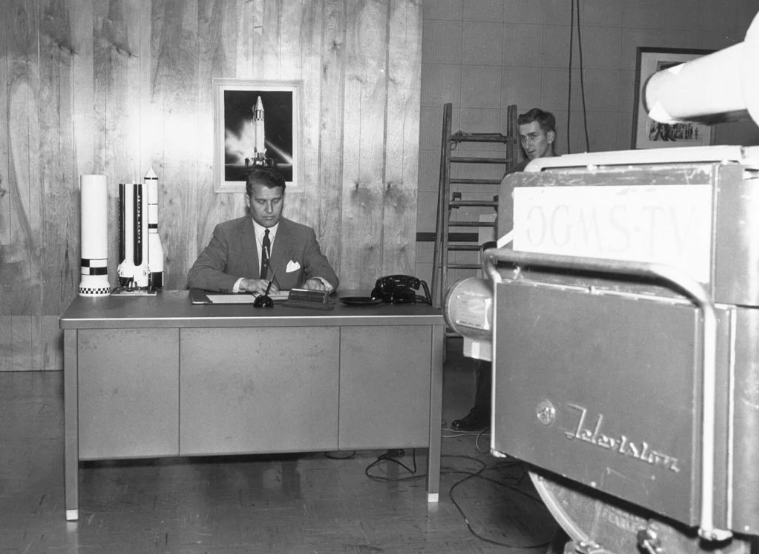 Wernher von Braun
Arthur Rudolph
A committed Nazi ideologue since 1931, Arthur Rudolph served as operations director of the underground Mittelwerk factory in Nordhausen, where slave labor was extensively used in the production of V-2 rockets. His office was located near the execution areas for enslaved workers.
In the United States
Rudolph became project manager for the Saturn V rocket and was widely praised as one of its principal designers. However, his links to war crimes resurfaced during the 1980s. In 1984, he renounced his American citizenship and left the country to avoid prosecution.
Hubertus Strughold
He supervised medical experiments in Berlin and had subordinates involved in potentially lethal tests conducted on concentration camp prisoners. He also authorized dangerous experiments on epileptic children.
In the United States
Strughold was transferred to the School of Aviation Medicine at Randolph Air Force Base in Texas. He became scientific director of the department of space medicine and was internationally recognized as the “Father of Space Medicine.”
In 1977, the U.S. Air Force aeromedical library was named after him. In addition, the Aerospace Medical Association created the Hubertus Strughold Award in his honor.
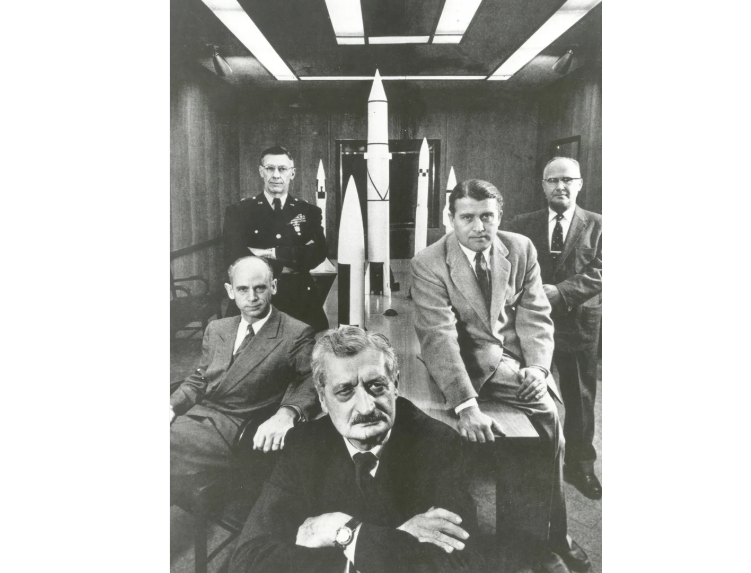 Officials of the Army Ballistic Missile Agency
The Moral Consequences of the Operation
It is true that the United States was unlikely to accept allowing the Soviet Union to monopolize the capture of German scientists and technological projects after the war. There was an obvious strategic interest in preventing a future rival from obtaining decisive technological superiority.
However, what the United States did went beyond merely preventing Soviet dominance over these specialists. The American government chose to compete in this arena while simultaneously rehabilitating war criminals within American society, concealing their Nazi pasts and offering them positions, high salaries, citizenship, and public honors despite their involvement with the Third Reich’s machinery of war and extermination.
These individuals could have been prosecuted, convicted, and later employed as technical consultants under state supervision without erasing or minimizing their moral responsibility. Transforming them into national heroes — or into symbols of the American space race, as happened with Wernher von Braun — amounted to rewarding men directly connected to a genocidal regime.
It is a deeply uncomfortable historical irony: individuals associated with the Nazi war effort eventually came to publicly represent the scientific and technological values of the leading Western power of the postwar world.
Utility does not eliminate responsibility. Technical collaboration does not require moral absolution. The transformation of these men into heroes was, above all, a political choice.
 Wernher von Braun, America Space Program
Conclusion
Operation Paperclip became a symbol of the logic of modern states, where pragmatism frequently overrides justice and morality, and where science is treated as an absolute value in service of state power.
The defeat of the Axis powers was proclaimed as a triumph of goodness, morality, and the values the Allies claimed to defend. Yet the postwar period revealed a far more ambiguous reality. While thousands of Germans were prosecuted and condemned, men directly linked to the Nazi regime were quietly incorporated into the military and scientific structures of the victorious powers.
More than simply making use of technical knowledge obtained from Germany, the United States chose to rehabilitate figures implicated in war crimes, granting them prestigious positions, high salaries, citizenship, public honors, and even the status of national heroes. Their strategic usefulness ultimately relativized their moral responsibility.
Operation Paperclip exposes an uncomfortable contradiction within modern international politics: even after the largest conflict in contemporary history, ethical principles remained subordinate to the strategic interests of states. In struggles for power, scientific knowledge, military capability, and geopolitical advantage often become more important than justice, memory, or historical accountability.
References
-
Annie Jacobsen.
Operation Paperclip: The Secret Intelligence Program that Brought Nazi Scientists to America (2014) -
U.S. National Archives.
Operation Paperclip Collection
https://www.archives.gov/research/foreign-policy/related-records/rg-330-paperclip -
Hoje no Mundo Militar
Operação Paperclip
https://www.youtube.com/watch?v=i2nZOITebb0&t=235s