
The Asch Conformity Experiment: The Weight of Collective Opinion
United States, Pennsylvania, Swarthmore College, early 1950s.
A group of college students enters a room to take part in what appears to be an extremely simple test: looking at a series of vertical lines and identifying which one matches the length of a reference line.
One participant notices that the others keep giving obviously wrong answers — yet they all answer the same way. At first, he finds the situation strange and responds according to what he clearly sees, disagreeing with the group. But after two or three rounds of standing alone, he begins deliberately giving the wrong answers as well.
That became the most common behavior among participants in Solomon Asch’s conformity experiment.
The study revealed something profound about human nature: our need for social belonging is often strong enough to override even our own direct perception of reality.
Details of the experiment
The main test took place in a room with:
- around 7 to 9 people;
- all but one were actors working with the researcher;
- only 1 person was an actual participant.
The task itself was simple: participants had to say out loud which line matched the length of a reference line.
There were 18 rounds in total, and 12 of them contained the real test. During those rounds, the group of accomplices intentionally gave the wrong answer.
The first few rounds were answered correctly to make the group appear trustworthy and the situation feel natural.
Results
Roughly 75% of participants gave the wrong answer at least once. In other words, 3 out of every 4 people conformed to the group at some point.
On average, participants followed the group’s incorrect answer in 37% of the critical rounds.
About 25% of participants remained independent and answered correctly throughout the entire experiment. In other words, 1 out of 4 never yielded to group pressure.
The results did not reveal blind conformity in every case, but rather a constant tension between personal perception and social belonging.
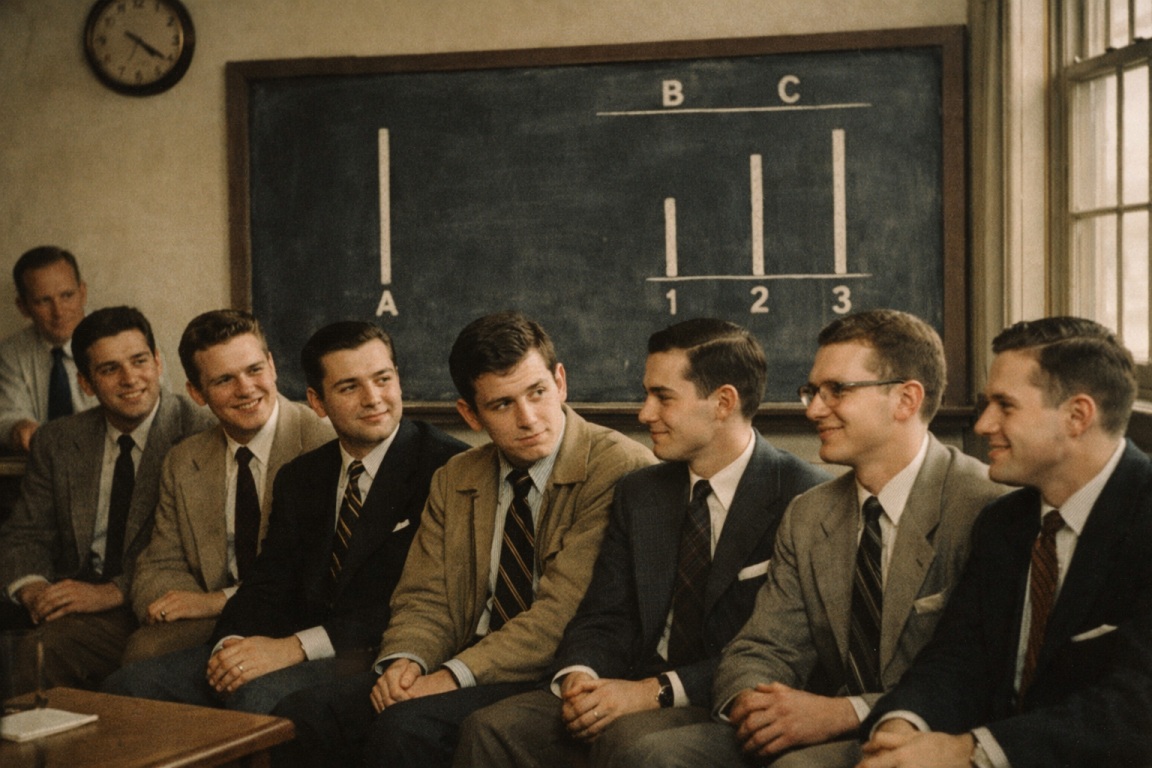 Participant under social pressure during the experiment
Variations of the experiment
When even a single person in the room gave the correct answer, conformity dropped dramatically — from 37% to around 7.5%.
This suggested that many participants were not necessarily looking for majority approval; they simply did not want to stand alone against the group.
Asch also varied the number of accomplices. Conformity increased gradually with one, two, and three people giving incorrect answers. Beyond three, however, the effect no longer grew significantly.
In other words, a large crowd was not required to create social pressure. Just three people were enough to produce a powerful effect.
When participants were allowed to answer anonymously by writing their responses on paper, conformity dropped considerably.
This suggested that part of the effect came from the desire for social acceptance rather than from a genuine belief that the group was correct.
When the lines shown were more visually similar, conformity increased even further. Faced with the group’s unanimous but incorrect answers, some participants genuinely began to question their own judgment.
Participants’ observations
Many participants later reported feeling:
- anxious;
- nervous;
- uncomfortable;
- confused;
- afraid of being judged by others;
- socially isolated.
Some even described sweating and intense emotional tension during the test.
Most accounts pointed to the discomfort of being excluded from the group and the feeling of isolation despite knowing they were right.
Others revealed something even more striking: some participants eventually began to distrust their own senses.
The experiment’s relevance in the real world
Looking at the results of Solomon Asch’s experiments, it is difficult not to draw parallels with modern society.
In a world where media, institutions, and social networks possess unprecedented technological power to shape public opinion, many people end up following apparent consensus — even when that consensus may not reflect reality.
For some, the truth or moral value of an opinion becomes less important than the perception that the majority stands against them, even if that majority is artificial, exaggerated, or merely superficial.
 Participant alone after the experiment
Conclusion
When people first hear about the experiment, many assume the participants were weak or naïve. But the study was never meant to expose individual weakness. Its purpose was to reveal the weight of social dynamics that every human being carries within them.
More than anything, the experiment demonstrates how deeply the desire for belonging can shape human behavior. It shows how powerful psychological isolation can be — and how emotionally costly public disagreement may become.
But perhaps the most unsettling aspect of the experiment is not that some people lied in order to fit in.
It is that many eventually began to doubt their own eyes.
References
-
Solomon Asch.
Opinions and Social Pressure (1955) -
Solomon Asch.
Studies of Independence and Conformity (1956)
